
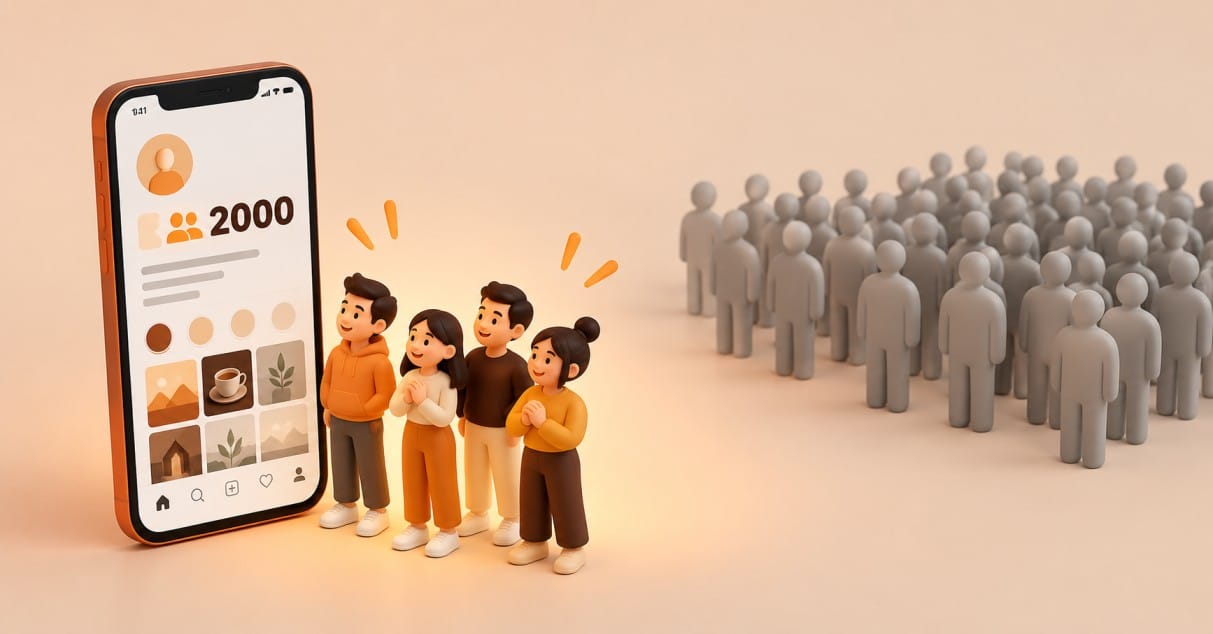
You have 2,000 followers. You publish a post. Then you check the numbers and wonder what went wrong. Maybe 60 people saw it. That isn’t necessarily a content failure. It is the reality of organic social media distribution in 2026.
Facebook Page organic reach is commonly reported around 1-3%, meaning a page with 2,000 followers could reach roughly 20-60 people organically on a typical post. Instagram averages around 3-4% reach in recent benchmark data, with reach continuing to become harder to earn. LinkedIn company pages have taken an even bigger hit, with recent platform analyses reporting a 60-66% decline in organic reach between 2024 and 2026.
There is an important caveat: Facebook does not publish one official universal organic-reach percentage, so the 1-3% figure is a third-party benchmark rather than a Meta statistic.
The bigger point is simple: your follower count is not your distribution. Social platforms decide which followers actually receive your content. If your social media strategy still assumes that gaining 2,000 followers means having 2,000 people available to see every post, you’re working from an outdated model.
The Uncomfortable Reality of Organic Social Media Reach
Think of your followers as people who gave you permission to knock on their door, not people who promised to answer every time you knock. Algorithms filter what appears in feeds based on predicted interest, previous interactions, content type and other signals. That means posting more often does not automatically solve a reach problem.
The mistake many small businesses make is blaming themselves too quickly. They redesign the graphic, change the caption, add more hashtags and post again tomorrow. Sometimes the content really is weak. But sometimes the bigger issue is that the platform is simply showing the post to a tiny initial audience.
What 1-3% Facebook Reach Actually Means
If your Facebook Page has 2,000 followers and your organic reach is 3%, approximately 60 followers may see the post. At 1%, that number falls to about 20.
That is why Facebook marketing should not be built around publishing promotional updates on a Page and waiting for followers to react. Recent benchmarks put Facebook Page organic reach in a wider range of roughly 1.6-5.9%, depending on page size and other factors, while active Groups can generate substantially stronger distribution.
The lesson isn’t “Facebook is dead.” That’s lazy advice. The lesson is that broadcasting from a business Page is no longer enough.
Instagram Marketing: Reels and Consistency Matter More
Instagram is a different game because visual content gives you more opportunities to reach people who don’t already follow you. Reels, strong visual storytelling and useful short-form content can travel beyond your existing follower base.
But don’t confuse a Reel getting views with a successful business strategy. A video with 20,000 views that attracts nobody who could become a customer is less valuable than a 2,000-view video that reaches 100 genuinely relevant prospects.
Why Visual Storytelling Beats Promotional Posts
People don’t open Instagram hoping to see another advertisement disguised as a post. They want something interesting, useful, entertaining or relatable.
For a local restaurant, that could mean showing how a signature dish is prepared. For a fitness business, it could mean demonstrating a common training mistake. For a design agency, it could mean breaking down why a particular website works.
Show the problem, process, result or personality behind the business. That’s much more compelling than repeatedly saying, “We provide the best services.”
How Consistency Improves Instagram Reach
Consistency does not mean posting seven times a week just to hit a number. It means giving Instagram and your audience enough repeated signals to understand what you talk about and who should care.
A realistic Instagram marketing schedule might be three strong Reels or other valuable posts each week, supported by Stories that keep existing followers engaged. The goal is not to flood the feed. It is to create enough quality opportunities for the right people to discover you.
Facebook Marketing: Build a Community, Not Just a Page
Facebook still makes sense for many small businesses, particularly those serving a local audience. But the strongest opportunity is often community participation rather than constant Page promotion.
A local salon, school, restaurant, home-service company or retailer can benefit from being genuinely useful within relevant local communities. Answer questions. Share practical information. Participate in appropriate Groups. Create conversations around local issues and customer problems.
Why Local Engagement and Groups Still Work
Groups change the relationship between a business and its audience. Instead of shouting an advertisement into a crowded feed, you’re participating in a community where the topic already matters.
That doesn’t mean joining every local Group and dumping links everywhere. People notice that immediately. Give useful answers first. Promote only when it genuinely fits.
For Facebook marketing, community relevance can matter more than follower volume. A business with 800 highly relevant local followers and strong community relationships may generate more customers than a Page with 10,000 passive followers.
LinkedIn Marketing: People Beat Company Pages
LinkedIn is probably the clearest example of why follower count can be misleading.
Recent 2026 analyses report that LinkedIn company-page organic reach fell 60-66% from 2024 to early 2026. One analysis also reports that personal profiles can receive dramatically more reach than company pages.
That creates an obvious opportunity for small businesses.
Why Personal Profiles Get More Distribution
People want to hear from people. A founder explaining how they lost a major client, solved a difficult problem or learned something from a failed project is naturally more interesting than a company page announcing, “We’re excited to share our latest update.”
Your company page still matters for credibility, basic information and brand presence. But if you’re a founder, consultant, agency owner or B2B professional, your personal LinkedIn profile should usually carry much of the organic content strategy.
Build Thought Leadership Around Real Experience
You don’t need to pretend to be a guru. Share things you have actually seen.
Explain a mistake you made. Break down a customer problem. Challenge an assumption in your industry. Show how you approach a difficult decision. Teach something that took you years to understand.
That’s thought leadership without the cringe.
Stop Trying to Be Everywhere
One of the biggest social media strategy mistakes small businesses make is trying to maintain Instagram, Facebook, LinkedIn, YouTube, X and everything else at the same time.
The result is predictable: mediocre content everywhere, inconsistent posting and a business owner who eventually gets tired of doing it.
You do not need to win every platform. You need to become useful somewhere.
Choose One or Two Platforms That Fit Your Audience
Start with your customers, not the platforms.
If you sell visually appealing products to consumers, Instagram may deserve most of your attention. If your customers are local families, Facebook may be stronger. If you sell B2B services, LinkedIn may be the obvious priority.
A focused social media strategy gives you enough repetition to learn what works. You can expand later when you have a repeatable content system.
Social Media Strategy: What Small Businesses Should Do Next
Stop measuring success only by followers and likes. Track whether your content is reaching the right people, generating profile visits, starting conversations, producing enquiries and eventually contributing to sales.
Your practical plan can be simple:
- Pick one primary platform and one secondary platform.
- Create 3-4 repeatable content themes.
- Publish useful content consistently for at least 8-12 weeks.
- Study which posts generate meaningful engagement, not just views.
- Turn successful topics into multiple formats.
- Make your strongest content about customer problems rather than your company.
The uncomfortable truth is that organic reach is limited. The useful truth is that you don’t need everyone to see your content. You need the right people to see enough of it to remember you.
Platform Comparison
| Platform | Best for | Best content format | Realistic organic reach expectation |
| Consumer brands, creators, visual businesses | Reels, Stories, carousels | Around 3-4% average reach benchmark, with significant variation | |
| Local businesses and community-led brands | Groups, Reels, community posts | Often around 1-3% for Pages, depending on account and content | |
| B2B, consultants, agencies, professionals | Personal posts, documents, thought leadership | Company pages face much lower distribution; recent analyses report a 60-66% decline since 2024 |
These figures are benchmarks, not guarantees. Platform algorithms, audience quality, content format and engagement can move individual results significantly.
Conclusion
Your 2,000 followers are not 2,000 guaranteed views. That’s the uncomfortable reality behind disappointing social media numbers in 2026.
Facebook Pages may reach only a small fraction of their followers organically. Instagram requires stronger visual content and consistent publishing to compete for attention. LinkedIn is increasingly rewarding people and expertise over company-page broadcasting.
The answer isn’t to post everywhere and hope something works. Build a focused social media strategy, choose the one or two platforms where your customers actually spend time, and create content that gives those people a reason to stop scrolling.
If your current instagram marketing, facebook marketing or linkedin marketing isn’t generating enough reach or enquiries, get in touch for a free social media strategy consultation. We’ll look at where your audience actually is, what’s holding your organic reach back, and what you should focus on next.
FAQs About Organic Social Media Growth
1. Why do my posts reach so few followers?
Because following a page does not guarantee that someone will see every post. Social platforms filter content and distribute posts based on their recommendation and ranking systems. A low reach percentage can therefore happen even when your follower count looks healthy.
2. Is organic social media reach dead?
No. But easy organic reach is largely gone. Businesses can still reach non-followers and generate customers organically, but the content generally needs to be more relevant, useful, entertaining or community-driven than a basic promotional post.
3. Should I post on Instagram, Facebook and LinkedIn every day?
Probably not. For most small businesses, spreading limited time across three platforms is a bad trade. Start with one or two platforms that match your actual customers and build a consistent content system before expanding.
4. Should I focus on my LinkedIn personal profile instead of my company page?
If you’re a founder, consultant or B2B professional, usually yes for organic distribution. Your company page still has value, but recent analyses show a major decline in company-page reach and significantly stronger distribution for personal profiles.
5. What should I measure instead of follower count?
Track reach among relevant people, engagement quality, profile visits, website visits, enquiries and conversions. A smaller audience that repeatedly interacts with your business is far more valuable than thousands of followers who never notice your posts.