
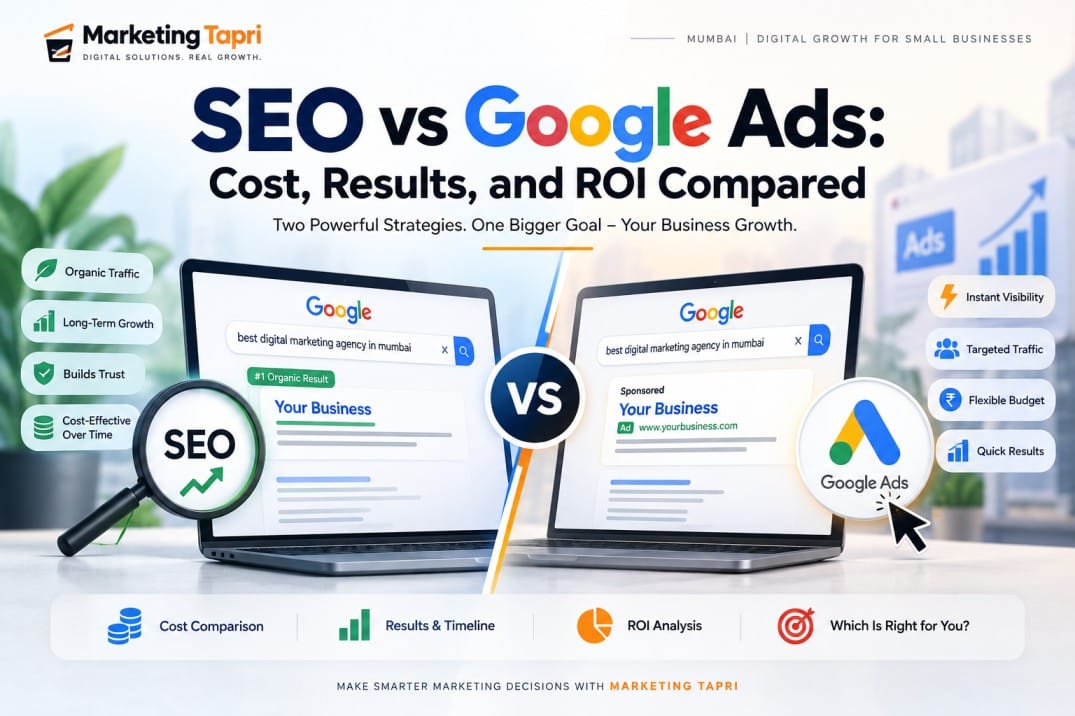
If you run a small business, you may have asked a simple but difficult question: Should I invest my marketing budget in SEO or Google Ads?
The answer depends on what you need, how quickly you need it, and what your business can afford to spend to acquire a customer. SEO vs Google Ads is not really a question of which channel is universally better. SEO builds organic visibility over time, while Google Ads can put your business in front of relevant searchers much faster.
This guide compares SEO vs Google Ads cost, results, speed, ROI, and practical use cases, with a focus on small and growing businesses.
SEO vs Google Ads: What’s the Difference?
The fundamental difference is simple:
SEO = organic search visibility.
Google Ads = paid search visibility.
SEO involves improving your website, content, technical structure, and relevance so that search engines can rank your pages organically.
Google Ads uses paid advertising campaigns to show your business for relevant searches. You typically pay when someone clicks your advertisement in a PPC campaign.
Both can attract people who are actively searching, but they work differently and require different investments.
What Is SEO?
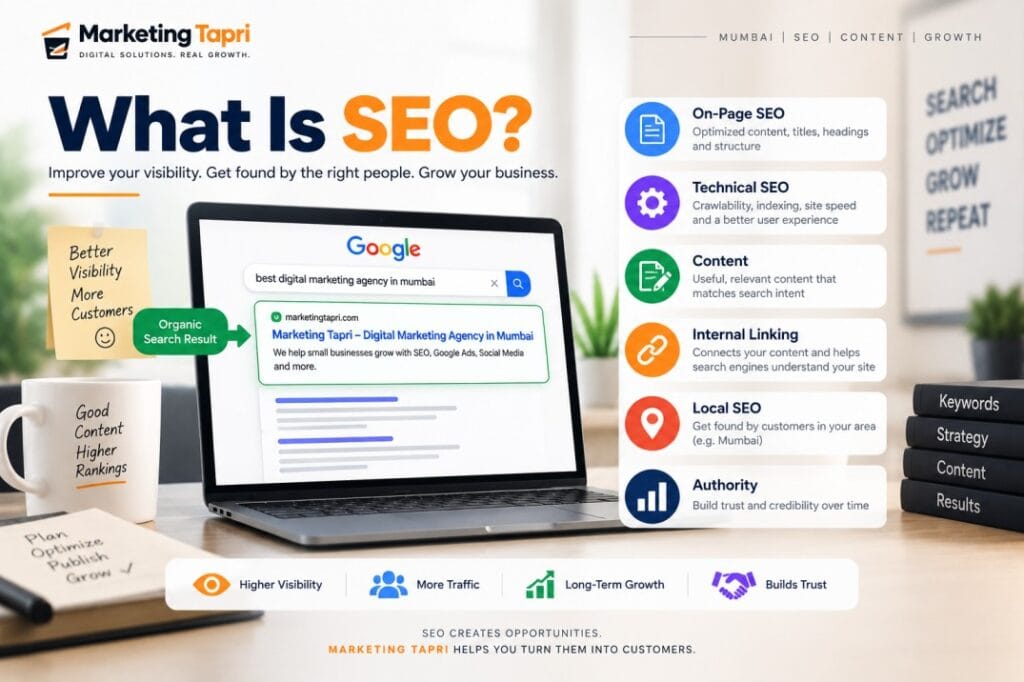
Search engine optimization (SEO) is the process of improving a website’s ability to appear in organic search results.
SEO can include:
- On-page SEO and content optimization
- Technical SEO
- Internal linking
- Search intent research
- Local SEO
- Website improvements
- Content creation
- Building website authority
For example, a Mumbai-based service business might create useful service pages and location-specific content to reach people searching for relevant services in Mumbai.
SEO can create long-term organic visibility, but it usually requires ongoing work. There is no guaranteed timeline for achieving specific rankings because competition, website quality, search demand, and many other factors affect organic results.
What is Google Ads?
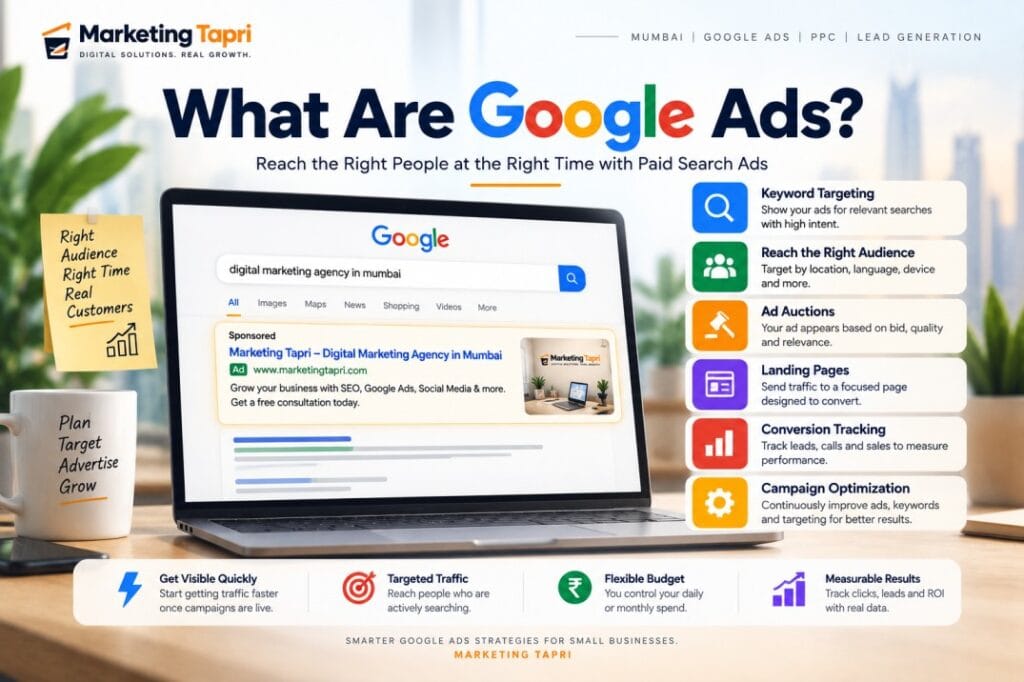
Google Ads is a paid advertising platform that allows businesses to reach potential customers through search and other Google advertising placements.
Search campaigns can involve:
- Keyword targeting
- Search intent
- CPC, or cost per click
- Ad auctions
- Geographic targeting
- Landing pages
- Conversion tracking
- Campaign optimization
Google Ads can generate paid traffic relatively quickly once campaigns are approved and active. However, paying for clicks does not automatically make a campaign profitable.
A relevant keyword, compelling offer, effective landing page, accurate conversion tracking, and good lead quality all matter.
SEO vs Google Ads: Quick Comparison
| Factor | SEO | Google Ads |
| Traffic source | Organic | Paid |
| Speed | Generally slower | Generally faster |
| Cost model | Investment in SEO work | Ad spend plus possible management costs |
| Long-term value | Can build lasting visibility | Depends on continued advertising |
| Control | Less direct control over rankings | More control over targeting and budget |
| Testing | Usually slower | Faster for testing offers and keywords |
| Best suited for | Long-term organic growth | Faster demand capture and testing |
Neither option is automatically the right choice for every business.
SEO vs Google Ads Cost
The SEO vs Google Ads cost comparison can be misleading because they use different cost models.
SEO costs may depend on your website’s condition, competition, content requirements, technical work, local SEO needs, authority-building efforts, and whether you use an agency, freelancer, or in-house team.
Google Ads costs depend on factors such as CPC, keyword competition, location, search demand, conversion rate, landing-page performance, and budget.
Remember that ad spend and Google Ads management fees are separate costs.
SEO is also not “free traffic.” Although you do not normally pay for each organic click, SEO requires investment in strategy, content, technical work, tools, and implementation.
Which Produces Results Faster: SEO or Google Ads?
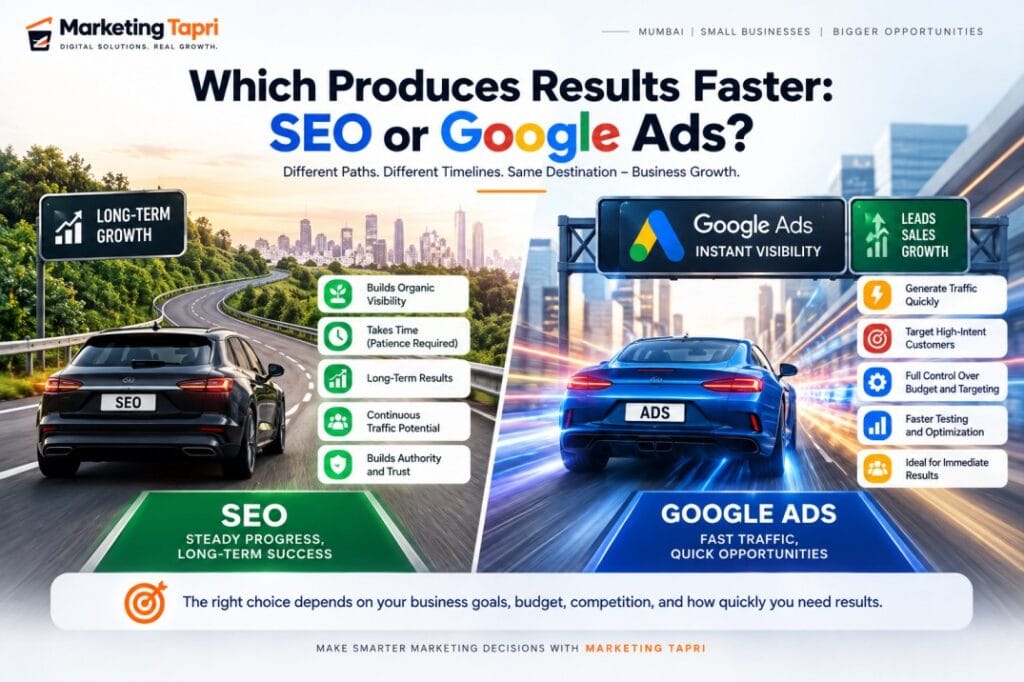
If speed is your priority, Google Ads can generally produce paid traffic faster once a campaign is live.
SEO usually takes longer because search engines need to crawl and index pages, understand their relevance, and evaluate them against competing results.
That does not make SEO ineffective. It simply means the two channels operate on different timelines.
A business that needs leads immediately may evaluate Google Ads, while a business building long-term organic visibility may invest in SEO. Some businesses may choose both.
SEO vs Google Ads ROI
ROI = (Revenue – Marketing Cost) / Marketing Cost
Consider a hypothetical example. If a business spends ₹20,000 on marketing and generates ₹60,000 in attributable revenue, its simplified ROI would be:
(₹60,000 – ₹20,000) ÷ ₹20,000 = 2, or 200%.
Actual marketing ROI can be more complicated.
For Google Ads, CPC, conversion rate, lead quality, sales close rate, margins, and customer lifetime value can significantly affect profitability.
For SEO, traffic quality, organic conversion rate, content investment, rankings, and the time required to generate meaningful traffic also matter.
Therefore, SEO vs Google Ads ROI should be evaluated using business outcomes, not clicks or traffic alone.
SEO vs Google Ads for Small Businesses
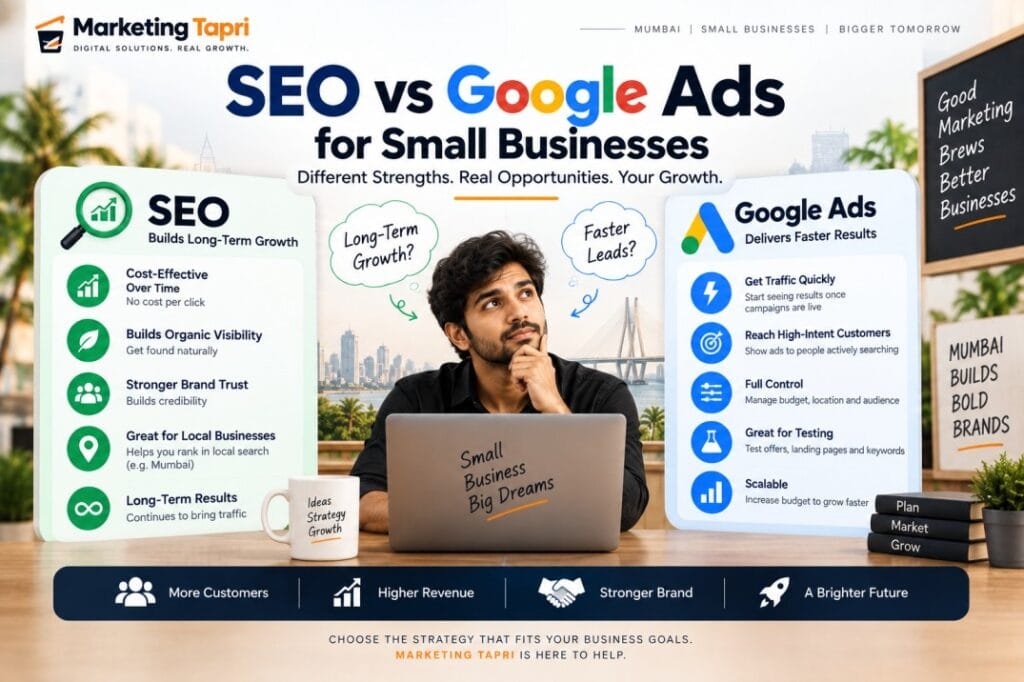
For SEO for small businesses, the channel can make sense when there is valuable search demand, useful content opportunities, local search potential, and the ability to invest consistently over time.
Google Ads for small businesses may make sense when the business needs faster traffic, has high-intent searches available, can track conversions, and has enough margin to support paid acquisition.
Local businesses may benefit from local SEO and geographically targeted Google Ads. E-commerce businesses need to consider product margins, average order value, repeat purchases, and conversion rates.
For a startup or new business, paid search can help test demand while SEO is developed as a longer-term acquisition channel.
Should You Use SEO and Google Ads Together?
Yes, when the economics and objectives support it.
Google Ads can provide faster demand capture and useful data about keywords, offers, and customer behaviour. SEO can build organic visibility that may become increasingly valuable over time.
Using both is not mandatory. The right combination depends on your budget, competition, search demand, conversion rate, customer value, and timeline.
How to Decide Between SEO and Google Ads
Before choosing SEO or Google Ads, ask:
- How quickly do I need results?
- What can I realistically spend each month?
- What is one customer worth to my business?
- Is there enough relevant search demand?
- How competitive is my market?
- Does my website convert visitors effectively?
- Can I accurately track leads and sales?
- Am I focused on immediate acquisition or long-term visibility?
These questions provide a much better basis for decision-making than simply asking which channel is cheaper.
Common SEO and Google Ads Mistakes
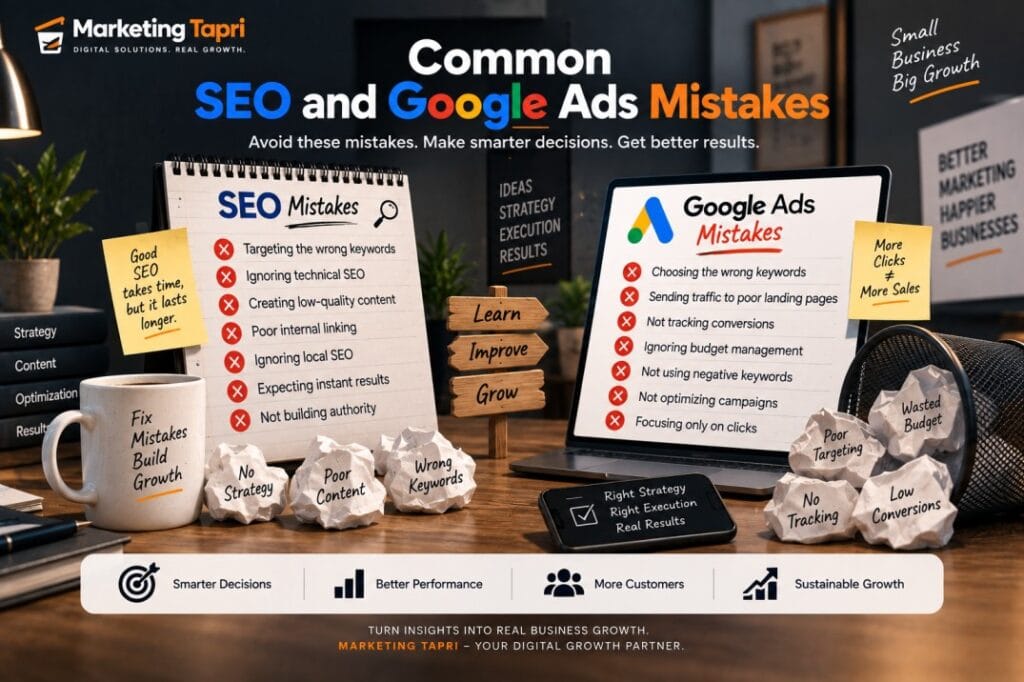
Businesses often make avoidable mistakes with both channels.
Common problems include:
- Targeting keywords without understanding search intent
- Sending paid traffic to weak landing pages
- Not tracking conversions
- Measuring clicks instead of qualified leads or sales
- Expecting instant SEO results
- Stopping SEO too early
- Ignoring negative keywords in Google Ads
- Failing to test landing pages
- Ignoring customer lifetime value
The goal should always be to connect marketing activity with actual business outcomes.
Frequently Asked Questions About SEO vs Google Ads
Is SEO better than Google Ads?
Neither is universally better. SEO can support long-term organic visibility, while Google Ads can provide relatively fast paid traffic. The appropriate option depends on your goals, budget, competition, search demand, conversion rate, customer value, and timeline.
Is SEO cheaper than Google Ads?
Not necessarily. SEO does not normally charge per organic click, but it requires investment in content, technical improvements, strategy, and ongoing work. Google Ads requires advertising spend and may also involve management costs. Compare total acquisition costs rather than simply comparing monthly fees.
Which gives faster results, SEO or Google Ads?
Google Ads can generally generate paid traffic faster once campaigns are active. SEO usually takes longer because pages need to be crawled, indexed, evaluated, and compete with other organic results. Faster traffic does not automatically mean better business results.
Which has better ROI, SEO or Google Ads?
There is no universal answer. ROI depends on factors such as conversion rate, CPC, customer lifetime value, margins, lead quality, sales close rate, and the total cost of generating organic traffic. Each channel should be evaluated against actual revenue and business outcomes.
Can SEO and Google Ads be used together?
Yes. A business can use Google Ads for faster demand capture while developing SEO for longer-term organic visibility. Paid campaign data may also provide useful insights for content and keyword decisions. Whether using both makes sense depends on the business’s economics and objectives.
How much should a small business spend on Google Ads?
There is no universal budget. The appropriate amount depends on CPC, search demand, conversion rate, customer value, margins, location, and how many leads or sales the business can handle. Start with a measurable budget rather than choosing a figure simply because another business spends it.
How long does SEO take to show results?
There is no reliable universal SEO timeline. Results can vary based on website condition, competition, search demand, content quality, technical implementation, authority, and the keywords being targeted. SEO should generally be viewed as an ongoing process rather than a guaranteed result within a fixed number of months.
Final Takeaway
SEO vs Google Ads is not about finding one universal winner. SEO can help businesses build organic visibility over time, while Google Ads can provide faster access to paid search traffic.
The right choice depends on your business model, budget, margins, search demand, competition, customer value, conversion rate, and desired timeline.
Marketing Tapri, a Mumbai-based digital marketing agency, helps businesses evaluate and implement strategies across SEO, local SEO, Google Ads, Meta Ads, social media marketing, and website development.
If you’re unsure whether your business should prioritize SEO, Google Ads, or both, contact Marketing Tapri to discuss which approach fits your goals, budget, and customer acquisition model.